

Is Annual Penetration Testing Still Enough in 2026?

Annual penetration testing proves your environment was secure. It says nothing about the version running in production today. Here is why passing the test and staying secure are two different problems.
Most security leaders operate under a widespread belief that needs to be named directly: if we pass our annual penetration test and remediate the findings, we have met our adversarial validation obligations and our security posture is defensible until next year's engagement. They hold this belief not because they're uninformed, but because, for decades, annual penetration testing was the most rigorous adversarial validation method available, and the compliance frameworks governing their industries codified it as the standard of due diligence. The honest case for annual testing is stronger than its critics admit.
The problem is the mismatch between when it was designed and how software ships now. Manual penetration testing validates real-world exploitability by chaining multiple vulnerabilities into a single attack path, unlike automated scanners that produce lists of individual potential flaws without confirming whether any of them can actually be reached or combined by an adversary. A scanner flags an exposed admin endpoint.
A human tester finds that endpoint, pairs it with a misconfigured session token, and demonstrates full account takeover. Those are different outputs entirely. That chained, human-reasoned attack path is what makes a penetration test report credible to a board or regulator.
It says the flaw is exploitable, and here is the proof. The annual cadence wasn't arbitrary. It was rational given the software delivery reality of the early 2000s, when most enterprises shipped on quarterly or biannual cycles.
Across the market, elite software delivery teams now deploy to production multiple times per day, while even low performers ship monthly rather than quarterly. The cadence that once aligned testing with release cycles no longer connects to anything in modern software delivery. A penetration test report proves one specific thing: that a defined scope of systems, as configured on a specific date, survived or failed adversarial scrutiny.
That proof is real. It is also immediately historical. Every pull request merged after the test closes is, by definition, untested.
The CISO who relies on a point-in-time snapshot for board reporting in March is presenting a security posture that describes a past version of the product. That's not negligence. It's the design limit of point-in-time validation operating inside a continuous delivery world.
Platforms like Parameter AI's AI Pentesting are built specifically for this condition: preserving the chained, exploitability-proven rigor of a manual engagement while running continuously, rather than anchoring findings to a calendar date the development team has already moved past.
Key takeaways
- Annual penetration testing fails not because it runs once a year, but because software ships daily and a point-in-time snapshot is stale the moment the next pull request merges.
- Passing a compliance-required pentest proves your environment withstood scrutiny at one specific moment, it proves nothing about the version of that environment running today.
- Up to 30% of software assets in a typical enterprise are unmanaged or untracked, which means most annual engagements are scoped against an incomplete picture of the actual attack surface.
- Five discrete events, M&A, major architecture changes, new cloud deployments, third-party integrations, and significant code releases, each create materially new attack surfaces that the last annual test never evaluated.
- Elite engineering teams ship changes in hours; the average enterprise runs one pentest per year. That structural mismatch is not a scheduling problem, it's a program design problem.
- The board question that exposes the real gap isn't 'when is your next pentest?', it's 'what changed since your last one?' If the answer requires a calendar, the architecture of your security program is the issue.
- Parameter AI's Continuous Penetration Testing closes that gap by running always-on security testing across code, cloud, and dependencies, so adversarial validation keeps pace with the rate of change instead of waiting for the next scheduled engagement.
What Compliance Frameworks Actually Require Annual Penetration Testing
Four major compliance frameworks set the floor for adversarial validation, and understanding exactly what each one demands is the starting point for any honest conversation about security posture. The common assumption among most CISOs and heads of security is that "if we pass our annual penetration test and remediate the findings, we have met our adversarial validation obligations and our security posture is defensible until next year's engagement." The gap between what these frameworks actually require and what genuinely secure organizations do is wider than that assumption, and wider than most audit calendars suggest.
1. PCI DSS Requirement 11.3 - Mandatory Annual Internal and External Network Penetration Testing
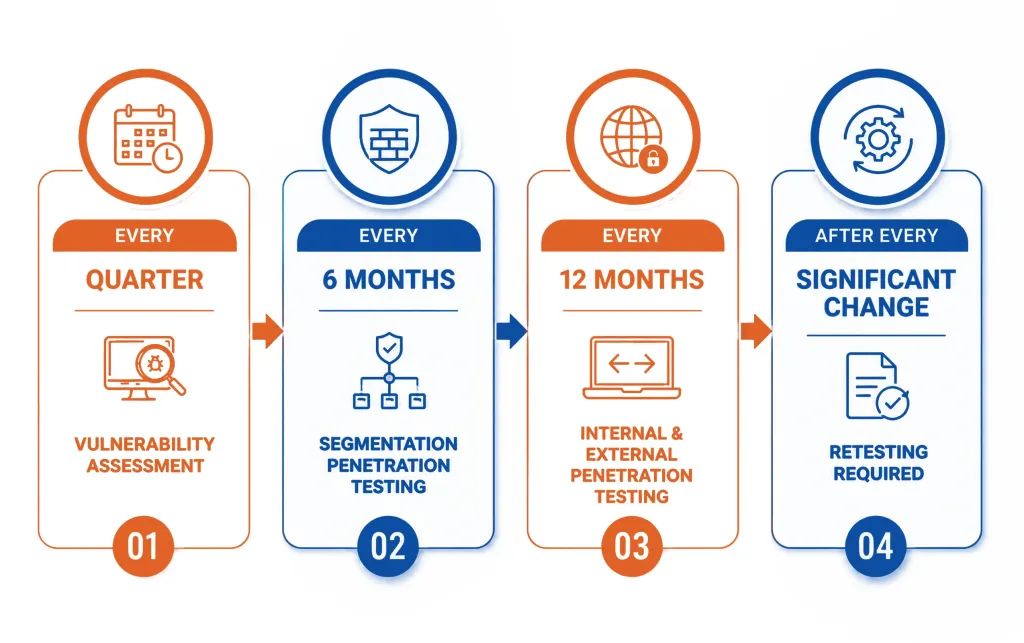
3 mandates annual internal and external network penetration testing, plus additional testing after any significant infrastructure or application change. That second clause carries real weight. In cardholder data environments where CI/CD pipelines ship frequently, the change-triggered retest obligation fires far more often than once a year, so the compliance and regulatory requirements for PCI DSS penetration testing are structurally more demanding than the annual headline suggests.
Testing must be conducted by a qualified internal resource or third-party tester with organizational independence. SOC 2 Type II audits widely rely on evidence of annual third-party penetration testing to demonstrate that operational security controls functioned effectively over the audit period. In practice, a missing or late report is one of the most common reasons audit opinions are delayed.
Consider a SaaS company that re-architected its AWS infrastructure three months after its last pentest concluded: the SOC 2 penetration testing evidence it submits describes an environment that no longer exists. Auditors notice. Qualified opinions follow.
2. SOC 2 Type II - Third-Party Annual Penetration Testing as Operational Security Evidence
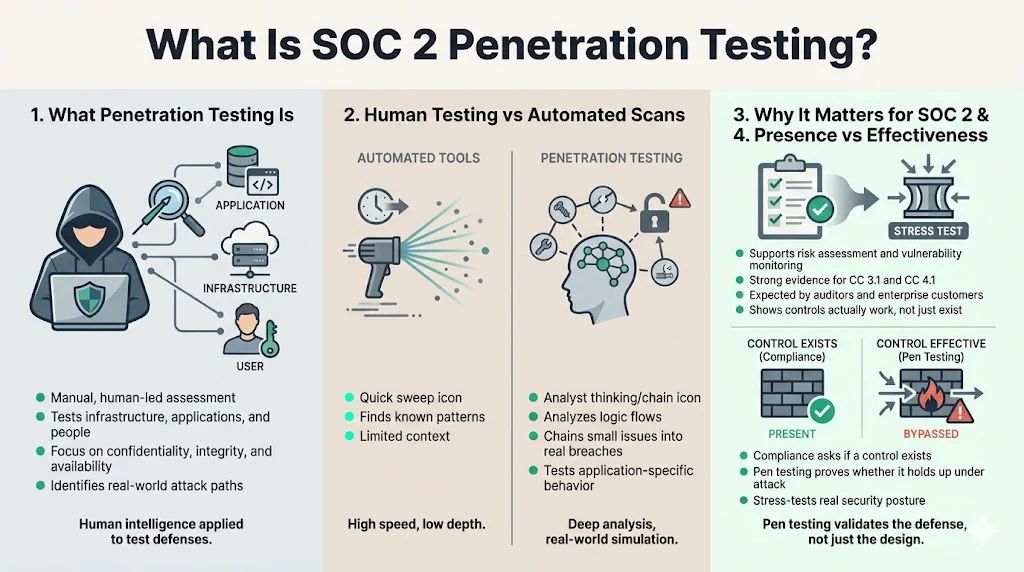
SOC 2 Type II auditors routinely expect annual penetration testing from an independent third party to validate that security controls are not just designed but operating effectively over the audit period. For SaaS vendors and cloud service providers selling to enterprise buyers, a missing pentest is often the single item that delays or degrades an audit opinion. The framework stops short of mandating a specific methodology, leaving scope ambiguity that can undermine report credibility.
3. ISO 27001 - Systematic Penetration Testing Within an Information Security Management System
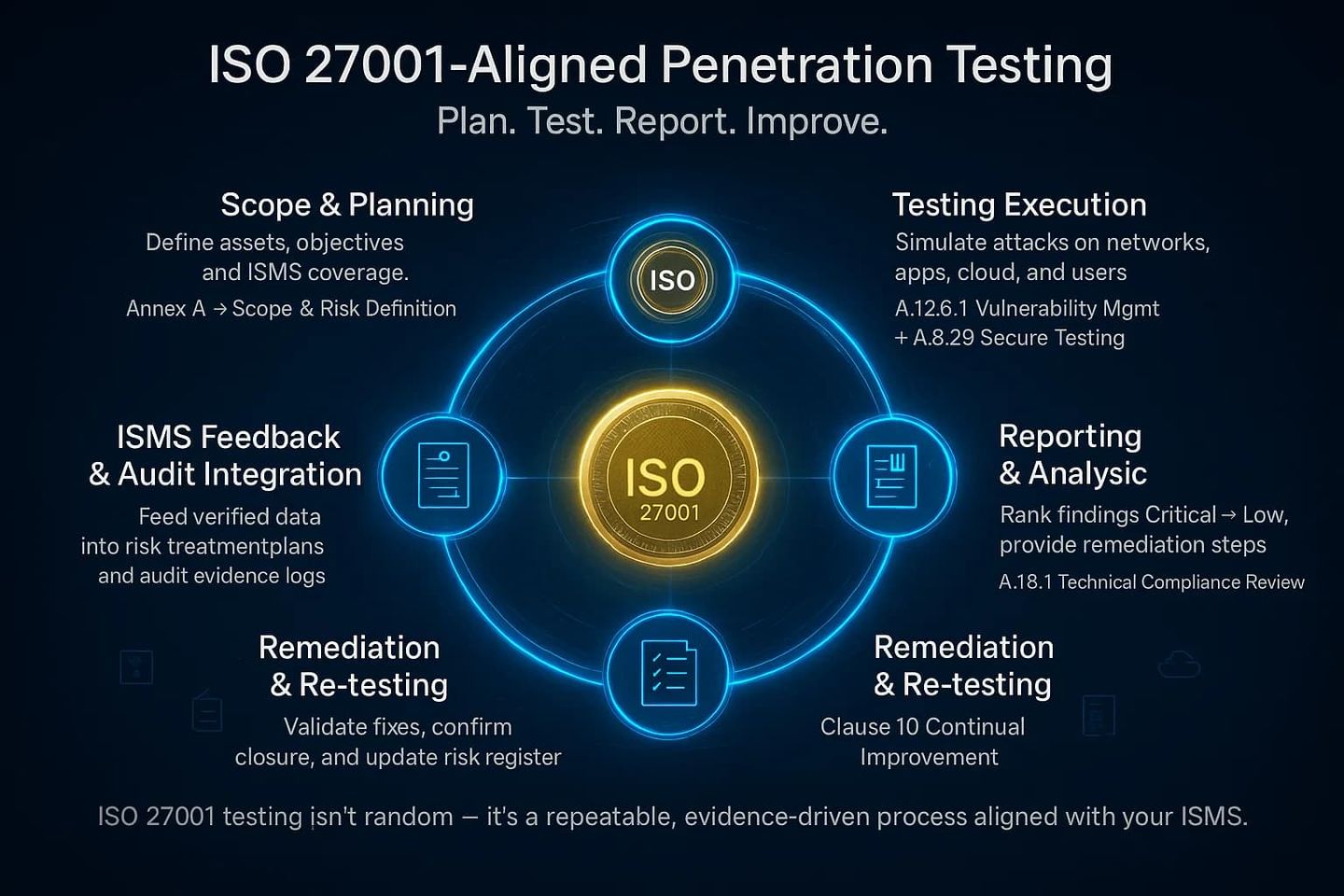
ISO/IEC 27001:2022 requires systematic vulnerability assessments and regular penetration testing as part of maintaining an Information Security Management System (ISMS), with frequency and scope determined by risk assessment rather than a fixed calendar mandate. This makes ISO 27001 security testing more flexible than PCI DSS, but also more demanding in one respect: organizations must document their rationale for the cadence they choose and defend it against auditor scrutiny. The proposed HIPAA Security Rule updates, published by HHS in January 2025, would elevate penetration testing from a recognized best practice to a near-explicit requirement for covered entities and business associates.
Healthcare security teams are watching this closely. The shift from addressable to required specification changes the enforcement exposure materially, and organizations that treated HIPAA penetration testing as optional now face the prospect of mandatory adversarial validation obligations with audit teeth.
4. HIPAA Security Rule Proposed 2026 Updates - Penetration Testing Elevated from Best Practice to Near-Requirement
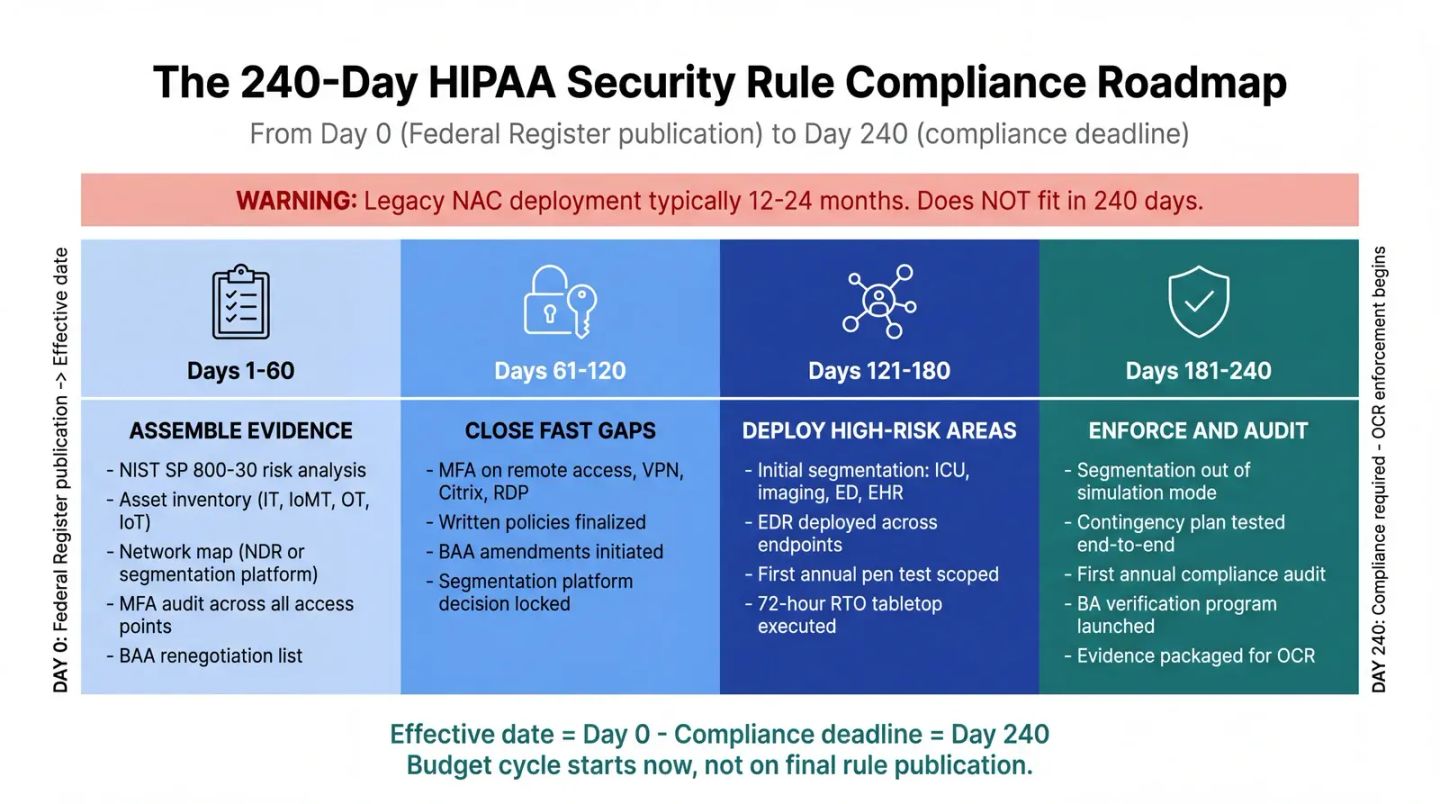
HHS's proposed 2026 HIPAA Security Rule amendments would transform penetration testing from an addressable best practice into a specific implementation requirement for covered entities and business associates protecting electronic protected health information. Healthcare security teams that have historically treated pentesting as optional now face a compliance deadline with real enforcement exposure. The rulemaking is still proposed, meaning timelines could shift, but organizations that delay planning risk scrambling when the rule finalizes.
5. The Compliance Scheduling Crisis - Pentest Is Always the Last Open Item When Audits Arrive
External penetration testing firms carry multi-week waitlists, and compliance deadlines do not flex to accommodate them. The result is a predictable crisis: the pentest is always the last open item, the report lands days before the audit window closes, and it describes an environment from six weeks ago. GRC teams reading that report are checking whether findings map to specific control gaps, but the infrastructure the report describes may have been modified a dozen times since the test concluded.
This is where the compliance floor becomes a trap. When the evidence artifact reflects last quarter's environment, the audit conversation is built on a document that is already out of date. Parameter AI's continuous penetration testing generates an always-current evidence stream across code, cloud, and dependencies, so the artifact submitted to auditors reflects the environment as it exists today.
PCI DSS, SOC 2, ISO that same figure, and HIPAA are converging on the same expectation: annual adversarial validation is the minimum, not the model. Organizations subject to multiple frameworks simultaneously face compounding scheduling and scoping complexity, with each framework's testing requirements overlapping in ways that strain both external firm availability and internal coordination capacity. The regulatory direction is clear.
Annual testing is the floor. The frameworks themselves are beginning to push beyond it. Satisfying a compliance checkbox and actually securing an environment are two different problems, and the gap between them widens every time a pull request merges after the pentest report is signed.
The next section examines why the environment changes so dramatically in the twelve months between tests that the annual cadence itself becomes the exposure.
6. Cross-Framework Regulatory Momentum - Why Annual Penetration Testing Is Now a Baseline Compliance Expectation
PCI DSS, SOC 2, ISO 27001, and the evolving HIPAA Security Rule are converging on annual penetration testing as a baseline expectation rather than a differentiating control. Regulators and auditors increasingly treat the absence of a recent pentest as prima facie evidence of inadequate security governance, regardless of which specific framework applies. For organizations subject to multiple frameworks simultaneously, this convergence simplifies the business case for annual testing but compounds the scheduling and scoping complexity.
Why Annual Testing Necessary Doesn't Mean Annual Testing Sufficient
For security leaders managing fast-moving engineering organizations, the gap between what was tested and what now runs in production is not a theoretical concern, it is a structural consequence of modern release velocity. Routine patches, configuration changes, new cloud deployments, and employee turnover introduce cumulative security gaps that no annual snapshot can retroactively cover. A healthcare SaaS team shipping two sprints per week can merge many feature branches into production before their annual report has even been distributed internally, none of those branches ever touched by adversarial testing. The attack surface the testers mapped in January is not the attack surface that exists in July.
Every Pull Request Merged After the Report Is an Untested Attack Surface
Industry data makes the velocity problem concrete: elite DevOps performers deploy on-demand, multiple times per day, so teams can ship hundreds or thousands of changes per year, each representing an untested attack surface if security validation occurs only annually. Attackers operate on timelines measured in days, not quarters. High-performing engineering organizations have normalized deployment frequencies that make point-in-time security testing structurally incompatible with their release cadence.
Parameter AI's Autonomous AI Pentesting Agents run continuously against the environment that actually exists today, closing the gap that deployment frequency opens. Over 10,000 PRs are reviewed every day as part of the software development lifecycle, as dependencies are added, updated, or new CVEs are disclosed. A risk-based approach to testing frequency treats deployment velocity, cloud provisioning rate, and privileged access turnover as the primary inputs, not the compliance calendar, because the compliance calendar was designed to answer "did we test this year?"
not "are we secure right now?"

When Penetration Testing Should Be Triggered Beyond the Annual Schedule
Five discrete events should trigger a change-triggered penetration testing engagement regardless of where your organization sits in its annual schedule. Each one creates a materially new attack surface that the last test never evaluated.
1. Major Infrastructure Changes That Invalidate Your Last Annual Penetration Testing Baseline
Routine infrastructure changes, new cloud deployments, firewall rule updates, third-party API integrations, compound into a materially different attack surface within weeks of any prior engagement. Autonoma's April that same figure cost analysis confirms that infrastructure migrations create new attack surfaces the last test never evaluated, making out-of-cycle testing a necessity rather than a precaution. The limitation worth naming: triggered tests are budget-inefficient when procured ad hoc, often costing significantly more than retainer or continuous testing arrangements for equivalent coverage.
2. Industry-Specific Frequency Mandates That Supersede the Annual Default
Regulated verticals cannot treat annual testing as sufficient. UnderDefense's that same figure analysis identifies fintech, healthtech, and PCI-scoped e-commerce as sectors where quarterly or semi-annual change-triggered penetration testing is operationally required by mandate, not preference. PCI DSS Requirement 11.3 explicitly demands testing after significant infrastructure or application changes, meaning the compliance floor in these industries is already higher than most annual schedules deliver. Organizations outside these verticals should treat this as a directional signal, not a pass.
3. Aligning Penetration Test Windows to Sprint Release Cycles Instead of Calendar Quarters
The most defensible approach to knowing when to conduct penetration testing is to anchor engagements to sprint boundaries rather than quarterly calendar dates. UnderDefense's that same figure guidance recommends aligning test windows with release cycles so adversarial validation captures the highest-risk changes at introduction, not months after deployment. This works best when development velocity is high and the attack surface changes regularly. The honest constraint: external firms cannot flex to sprint cadences, which is precisely where the scheduling model breaks down structurally. Continuous Penetration Testing triggered by code changes or deployments, rather than a firm's availability calendar, resolves the structural mismatch, and scales across multiple engineering teams and repositories without proportional headcount growth.
4. The Vendor Waitlist Problem - Why Triggered Tests Begin After the Risk Has Already Evolved
Security teams that correctly identify every trigger still face a multi-week wait before an external firm begins work. UnderDefense's that same figure analysis makes this concrete: by the time a change-triggered engagement opens, further changes have already superseded the one that prompted it, leaving the organization perpetually behind its own attack surface. The compliance artifact that results certifies an environment that no longer exists. Parameter AI's Autonomous AI Pentesting Agents are most beneficial precisely here, when a team ships code frequently and cannot run manual pentests at the pace of development, autonomous agents run adversarial validation continuously throughout the software development and deployment lifecycle, eliminating the queue between a triggering event and an actual test start.
5. Post-Breach and Post-Incident Testing as a Non-Negotiable Supplemental Trigger
A confirmed breach or security incident invalidates every assumption the last engagement made about your environment. Practitioners who wait for the next scheduled window after an incident are, in effect, certifying a compromised baseline. The scope that matters post-incident includes not just the affected system but every adjacent asset that shares credentials, network segments, or dependency chains with the breached component.
This is most consequential in cloud environments where blast radius is wide and lateral movement paths are rarely visible until adversarial validation maps them explicitly. When security teams are triaging findings after a test run, particularly when overwhelmed by high-volume scanner noise, Proven Findings provide immediately actionable signal, most impactful at the moment remediation decisions must be made rather than days later when the urgency has faded but the exposure has not.
Related Reading
- Benefits of Penetration Testing
- What Is Penetration Testing
- Types of Penetration Testing
- Penetration Testing Methodology
- Penetration Testing Cost
What Scope an Annual Penetration Test Must Cover to Remain Defensible
Adversarial validation of adjacent assets and dependency chains only holds if the asset inventory feeding the engagement scope is complete, and in most enterprises, it isn't. Cloud-native components such as serverless functions, ephemeral containers, and CI/CD pipeline integrations routinely go unlisted in the inventories used to define penetration test scope. The gap is structural.
The Minimum Defensible Scope for Web Apps, APIs, Cloud Infrastructure and Supply Chain
"Organizations struggle to define what scope is actually required for compliance-defensible penetration tests, making it hard to compare quotes for 'basically the same scope' (website, API, internal testing)."
— what we hear from cybersecurity compliance teams

- Web applications
- External APIs
- Cloud infrastructure
- Software supply chain dependencies
Broader industry trends make this concrete: enterprises use an average of over 1,000 cloud services, the majority unsanctioned or uninventoried by IT. Parameter AI's Continuous Penetration Testing addresses this directly: rather than anchoring scope to a point-in-time inventory negotiated at kickoff, coverage runs throughout the development lifecycle, triggered by code changes, deployments, or on a continuous schedule, so the perimeter being tested reflects the system as it actually exists. For dependency risk, Parameter AI's Dependency Security Testing is most beneficial for teams with large dependency graphs or reliance on open-source packages, running continuously as dependencies are added, updated, or new CVEs are disclosed; the attack surface introduced by a new package is tested the moment it enters the graph, not at the next annual engagement.
Parameter AI's Autonomous AI Pentesting Agents are most beneficial when a team ships code frequently and cannot run manual pentests at the pace of development, running continuously throughout the software development and deployment lifecycle, so ephemeral assets are tested during the window they are live rather than missed because they weren't present at scope sign-off.
Why the Compliance Scope Floor Consistently Falls Short
Frameworks are written to be auditable across thousands of organizations with wildly different architectures, forcing them toward the lowest common denominator: the web application, the internal network segment, the external perimeter.
Key takeaway: Organizations have, on average, 30% more IT assets than they are aware of or actively tracking. Parameter AI's Proven Findings capability is most valuable precisely in that moment, when teams are triaging after a test run and need signal separated from noise, delivered immediately upon receiving findings so that the issues most likely to translate into real-world impact reach the engineers who can close them.
Continuous vs Periodic Penetration Testing and Why the Gap Has Become Indefensible
That structural mismatch is what makes the continuous versus periodic debate more than a frequency argument. According to industry data, elite engineering teams measure change lead time in hours, not weeks, and deployment frequency as a continuous throughput metric, not a calendar event. Security validation anchored to a calendar cannot track a system that changes with every pull request merged.
A Periodic Report Describes a Past State and Continuous Testing Validates the Present One
The foundational assumption that made periodic testing rational was that a meaningful remediation window existed between when findings were discovered and when adversaries could act on them. That assumption no longer holds. Mean time to exploit newly disclosed vulnerabilities has collapsed to days or hours in recent threat intelligence reporting, and AI-accelerated tooling means exploitation now begins before patches are even available.
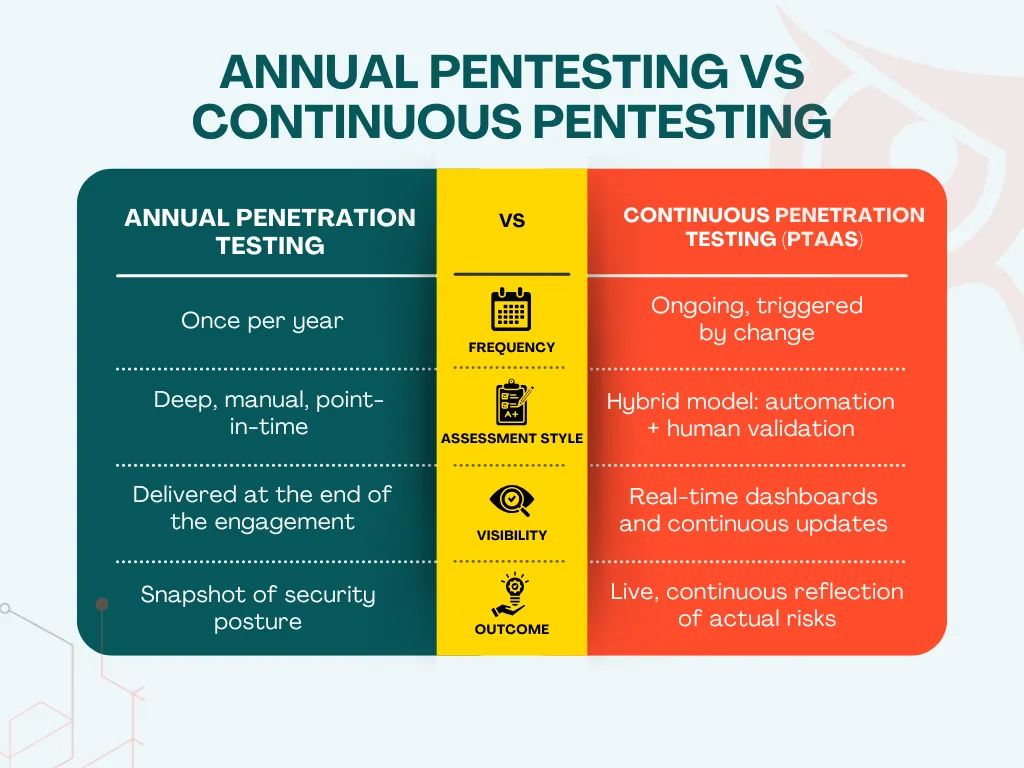
A penetration test report that takes weeks to deliver after the engagement closes is not describing your current environment. It is describing a version of your environment that no longer exists, tested against a threat landscape that has already moved. The gap is not fixable by running periodic tests more often.
More frequent snapshots still produce snapshots. Continuous penetration testing validates the present state because it runs adversarial testing in lockstep with every deployment, surfacing proven, exploitable attack paths at the moment they are introduced, not months after the fact. That distinction matters not only operationally but increasingly in how regulators and auditors interpret due care.

Organizations that continue treating the annual PDF as the artifact of record are accumulating a legally and operationally dangerous gap between what regulators accept as due care and what the actual threat timeline demands.
Scaling Human Testing to Match Development Output Is a Cost Equation That Doesn't Close
The economics of manual penetration testing make that gap structurally unavoidable. Senior penetration testers in the US command significant six-figure compensation, and a single manual engagement still takes weeks to scope, execute, and report. A team shipping dozens of deployments per week would need a security team that grows linearly with development output.
No headcount budget closes that equation. AI Pentesting eliminates the exposure window that most CISOs have quietly accepted as unavoidable, deploying autonomous AI agents that continuously test web apps, APIs, and business logic the way a real adversary would. Every finding ships with a working proof-of-concept and reproduction steps and under 1% false positives, rather than delivering a report that describes a system that no longer exists.
Related Reading
Next steps
If your board is asking what your security posture looks like today and your honest answer points to a PDF from last quarter, the path forward starts with treating continuous adversarial validation as the program standard, not a supplement to the annual calendar.
The evidence makes the sequence plain. Mean time to exploit has collapsed to hours, yet most compliance calendars still treat an annual snapshot as sufficient proof of due care, creating a legally dangerous gap between what regulators accept and what the threat timeline actually demands. At the same time, elite engineering teams deploy to production multiple times per day, meaning the tested fraction of your live attack surface decays toward zero within weeks of any point-in-time engagement. Together, those two realities point to one conclusion: scheduling more frequent manual tests compresses the interval but never closes it, because the snapshot model is the problem, not the cadence.
Start with AI Pentesting to run adversarial validation continuously across code, cloud, and dependencies, triggered by deployments rather than calendar dates. Every finding ships with a working proof-of-concept, so triage is spent on confirmed, exploitable risk rather than scanner noise.
Related Reading
- Ai Pentesting Vs. Traditional Pentesting
- Internal Vs. External Penetration Testing
- Autonomous Penetration Testing Security Vendors
- Black Box Penetration Testing
Frequently Asked Questions
What are the real limitations of annual penetration testing?
An annual penetration test proves only that a defined scope of systems, as configured on a specific date, survived adversarial scrutiny, it says nothing about every change merged after that date. For teams shipping code daily or even weekly, the tested environment can drift dramatically from the live environment within days of the report being signed, leaving the vast majority of deployment events unvalidated.
What does PCI DSS actually require for penetration testing?
PCI DSS v4.0.1 Requirement 11.3 mandates annual internal and external network penetration testing, plus additional testing after any significant infrastructure or application change. In environments where CI/CD pipelines ship frequently, that change-triggered retest obligation can fire far more often than once a year, making the practical compliance burden more demanding than the annual headline suggests.
Does SOC 2 require an annual penetration test?
SOC 2 Type II audits widely rely on evidence of annual third-party penetration testing to demonstrate that operational security controls functioned effectively over the audit period, and a missing or late report is one of the most common reasons audit opinions are delayed. If your infrastructure was re-architected after the last pentest concluded, the evidence you submit describes an environment that no longer exists, which auditors notice.
Is penetration testing required under HIPAA?
Under the current rules, penetration testing has been a recognized best practice rather than an explicit requirement, but the proposed HIPAA Security Rule updates published by HHS in January 2025 would elevate it to a near-explicit requirement for covered entities and business associates. The shift from addressable to required specification materially changes enforcement exposure for healthcare organizations that previously treated penetration testing as optional.
How should organizations decide how often to run penetration tests?
The post argues that the right question is not how often to test but how fast your attack surface changes, with deployment velocity, cloud provisioning rate, and privileged access turnover serving as the primary inputs rather than the compliance calendar. For teams shipping daily, a risk-based approach means continuous adversarial validation aligned to the pace of development, not a fixed annual or quarterly cadence.